Building Africa's energy future
NuruGrids Africa is an energy technology company in Nairobi. Most of what we make is our own intellectual property: the software, firmware and hardware that let distributed energy work as one system.
Why we exist
Africa's energy transition needs more than new solar panels. It needs a way to make many small energy systems work together.
We work between the EPC contractor and the utility. We combine industrial edge computing and our own software to run separate energy assets as one network.
Our main product is NuruCore EMS, an energy management system on a single industrial gateway. It handles safety, talks to the devices on site, stores the readings and produces statements and compliance reports. It is built for net metering at commercial and industrial sites under Kenya's EPRA regulations, from the meter to the compliance report. It is at release 2.1, validated on our reference hardware and ready for pilot sites.

How we build it
Three choices shape our technology.
- Industrial edge computing
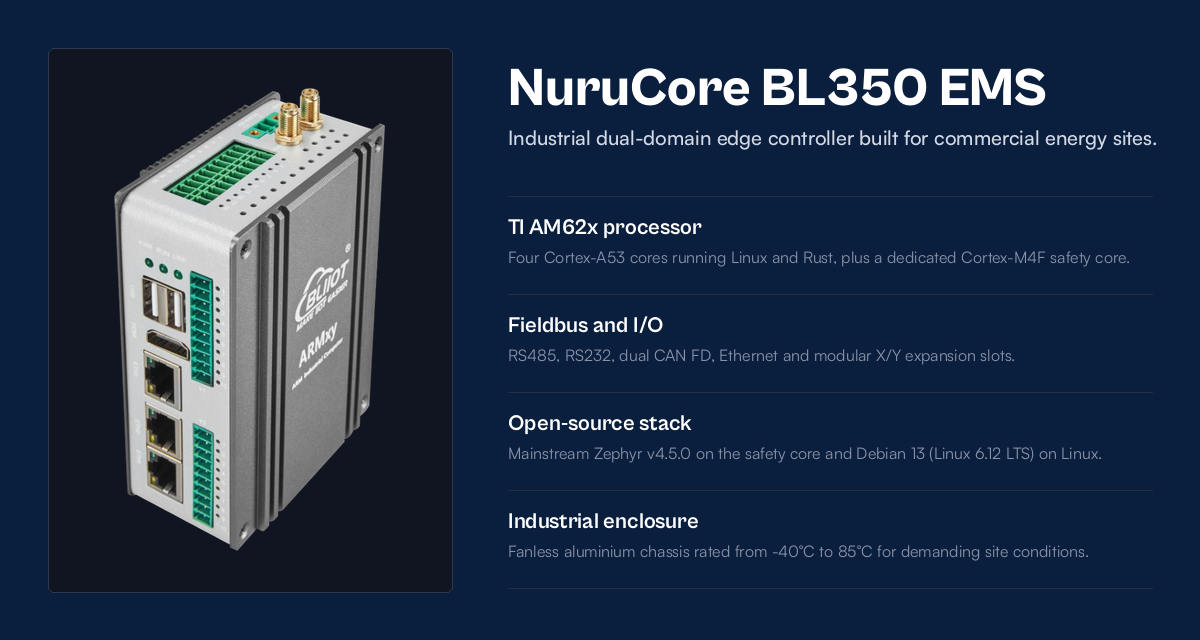
- NuruCore EMS runs on a TI AM62x processor with two kinds of core. A Cortex-M4F core running Zephyr RTOS runs the safety logic. Cortex-A53 cores running Linux run our EMS, written in Rust. The EMS reads meters, inverters and batteries over Modbus, DLMS/COSEM, CAN and M-Bus. A site keeps running without the cloud.
- NuruCore Fleet
- NuruCore Fleet is our own hosted view of every NuruCore EMS site. It stores each site's readings and statements and shows the whole portfolio in one place. It is read-only: it never changes anything on a site.
- On-device analytics
- We are building forecasting and anomaly-detection models that run on the gateway, with no round trip to the cloud. The runtime is in place. The trained models are in development.
Built on
NuruCore EMS stands on hardware and open source we did not make.
- BLIIoT
- The ARMxy BL350 industrial computer, the hardware NuruCore EMS runs on.
- Texas Instruments
- The AM62x processor inside the BL350, with four Cortex-A53 cores and a Cortex-M4F core.
- Zephyr Project
- The real-time operating system on the M4F core. Our BL350 board support is part of Zephyr from release 4.5.0, and we send our fixes back to the project. See the board page.
- Debian Linux
- Debian 13 on the A53 cores, with our own build of TI's Linux 6.12. Fixes we make to the kernel go to the Linux kernel mailing lists for review.
Kenya's energy market in 2026
Two sets of regulations have changed Kenya's electricity market. Businesses can export solar power for bill credit. Large consumers can buy power directly from generators.
80%
Share of Kenya's electricity generated from renewable sources.
Source: EPRA Energy and Petroleum Statistics Report, 2024/25
1 MVA
Minimum load at which a consumer may buy power directly from a generator.
Source: Electricity Market, Bulk Supply and Open Access Regulations, 2026, reg. 24(3)
100 MW
National cap on net-metered capacity for the first five years.
Source: Energy (Net-Metering) Regulations, 2024 (Legal Notice 104)
373 MW
Captive solar installed by Kenyan businesses, up from 301 MW a year earlier.
Source: EPRA, June 2026
Both need accurate metering, control of many types of device, and regular reports to EPRA. NuruCore EMS provides all three.
Let's build Africa's energy future together
Whether you are an investor, a partner or a customer, we would like to hear from you. We are also looking for equipment manufacturers who want their devices integrated, and for partners with pilot sites.