
· Open Source · NuruGrids Engineering
Status: Four contributions merged into the public Zephyr Project between August and November 2026, with three already shipped in Zephyr v4.5.0.
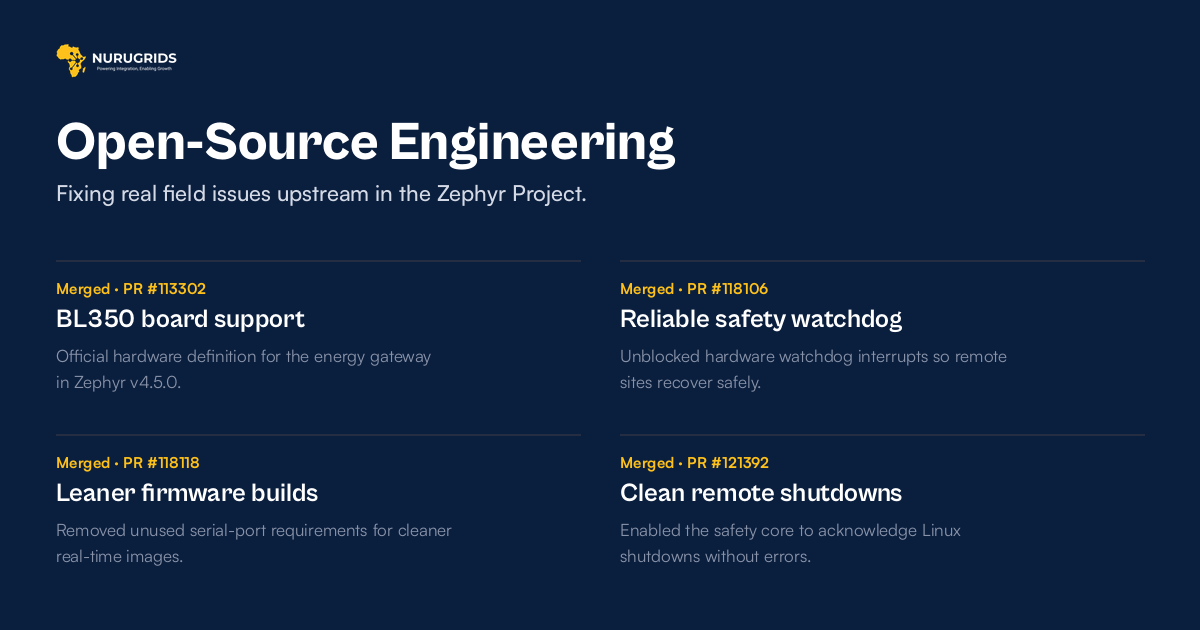
Many technology companies treat the software inside an industrial controller as a closed black box. When they hit a bug, they patch a private copy and move on. Over time, that private copy falls behind security updates and becomes fragile.
At NuruGrids Africa, we take the opposite approach. The safety core inside NuruCore EMS runs on the Zephyr Project, a widely trusted open-source real-time operating system backed by the Linux Foundation. Whenever our bench testing uncovers a real problem, we solve it properly and contribute the fix back to the public project.
1. Official support for the BL350 energy controller
The problem: Before August 2026, the Zephyr Project had no official support for the BLIIoT ARMxy BL350 controller we use for NuruCore EMS. Anyone building real-time safety software for this hardware had to maintain their own private setup.
Our solution: We wrote, tested and submitted the official board support in pull request #113302. It passed public review by Zephyr maintainers and now ships in mainstream Zephyr v4.5.0, giving our customers a transparent, publicly reviewed foundation.
2. Making the hardware safety watchdog work reliably
The problem: Remote energy controllers need a hardware watchdog, an automatic safety timer that resets the system if software ever freezes. On our processor family, enabling the watchdog warning alert failed to build.
Our solution: We traced the missing setting and fixed it cleanly in pull request #118106, now part of Zephyr v4.5.0. Remote sites get dependable hardware watchdog protection without fragile workarounds.
3. Keeping safety firmware lean and focused
The problem: In NuruCore EMS, Linux talks to solar inverters and meters over the controller's serial ports, so the safety core does not need a serial console of its own. Previously, Zephyr required one anyway on this chip, forcing extra unused setup into the safety image.
Our solution: In pull request #118118, also released in Zephyr v4.5.0, we made that requirement optional. The safety firmware stays smaller, simpler and easier to verify.
4. Clean, predictable remote restarts
The problem: During software updates or maintenance, Linux sometimes needs to ask the safety core to stop cleanly before restarting it. Without a proper acknowledgement from the safety core, Linux had to wait for a timeout and log an error.
Our solution: We added clean shutdown handshaking in pull request #121392, merged on 13 November 2026 for the next Zephyr release. Remote maintenance and firmware updates become cleaner and more predictable.
Why open engineering matters for energy buyers
Contributing upstream proves two things to businesses, utilities and partners working with NuruGrids Africa. First, our team understands the hardware all the way down to the processor level. Second, our clients are never trapped on abandoned, one-off software. Every fix we share becomes part of the global open-source standard that keeps NuruCore EMS reliable for years to come.